Many companies with configurable products eventually explore the idea of a 150% EBOM: a single engineering structure that contains all possible product variants, from which the individual 100% configurations are derived.
But very few ask the more fundamental question: How do we create a good 150% EBOM?
Most people assume it starts with BOM structuring or PLM configuration management. In reality, it starts much earlier with a System Breakdown Structure (SBS).
The SBS is created during systems engineering. It decomposes a product into systems and subsystems based on function and responsibility. In many organizations, however, the SBS is treated as a temporary artifact used for requirements allocation and then forgotten or not communicated to engineering.
That is a mistake.
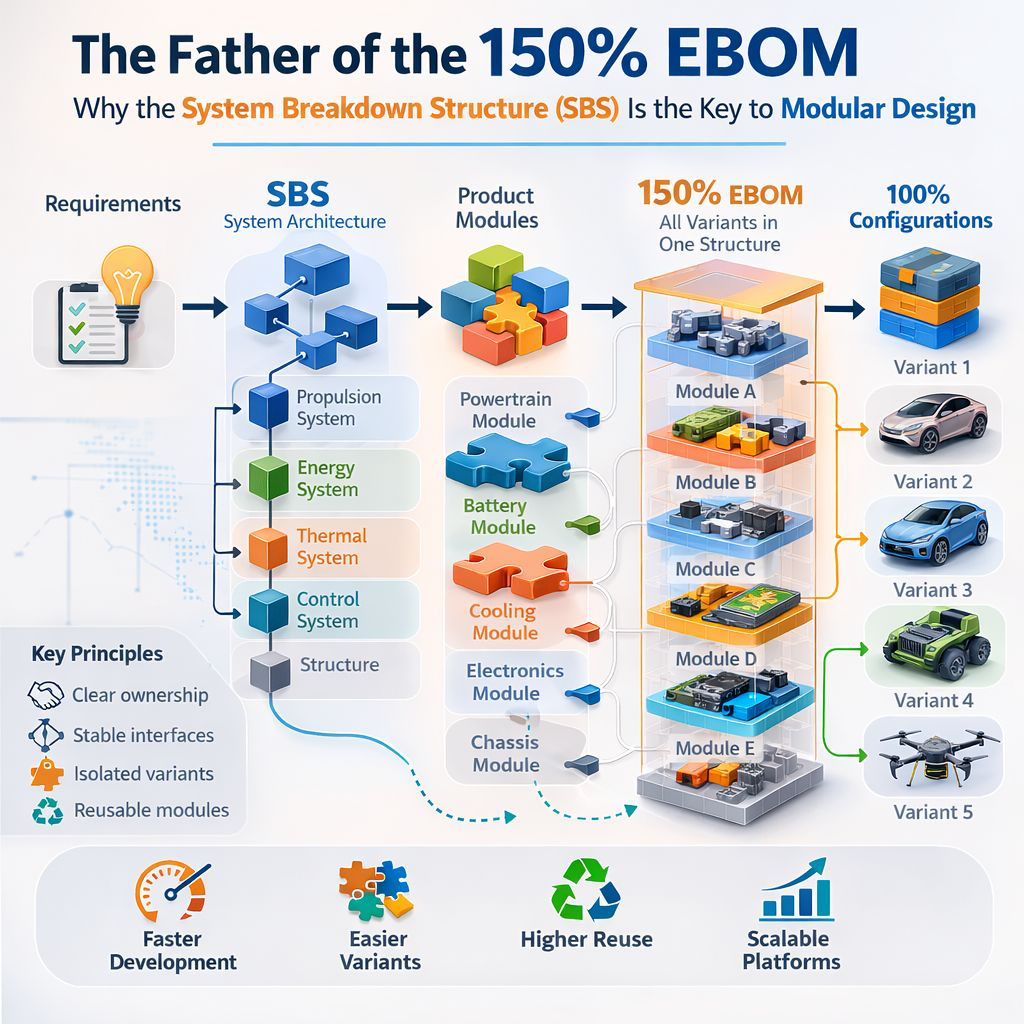
A well-designed SBS becomes the architectural blueprint of the product, and it ultimately drives the modular structure of the EBOM. In that sense, the SBS is the father of the 150% EBOM.
When modularization fails, the root cause is not the PLM system. It is almost always the product architecture. If the SBS is poorly structured or omitted, the EBOM will be messy: systems overlap, interfaces are unclear, and components depend on each other in unpredictable ways. Variant management quickly becomes unmanageable.
A good SBS, on the other hand, naturally leads to modular design. It should follow a few key principles.
First, each system must have clear functional ownership. Every subsystem should be responsible for a distinct function of the product.
Second, the SBS must define stable interfaces between systems. These may be mechanical, electrical, or software interfaces. Stable interfaces allow modules to evolve independently.
Third, the logical architecture and the physical architecture must align. Ideally, each major SBS element maps to a product module in the EBOM.
Fourth, variant drivers should be isolated in dedicated modules. When variants are confined to specific modules, the 150% EBOM becomes manageable.
When this architecture is in place, the sequence becomes straightforward:
Requirements → System Breakdown Structure (SBS) → Product modules → 150% EBOM → Configured 100% EBOMs
The benefits are significant:
- faster product development
- simpler variant management
- higher component reuse
- scalable product platforms
Many organizations try to solve modularization with optimizing the EBOM or better PLM tools. But PLM cannot fix a bad architecture. It can only manage the structures engineering creates.
So if you want a clean 150% EBOM, don’t start with the BOM.
Start with the System Breakdown Structure.
Because in modular product development, the SBS is the father of the 150% EBOM.