Many product development challenges start with a disconnect: Requirements are defined in one tool, systems are designed somewhere else, and the engineering product structure lives in yet another system. The result is lost traceability, unclear responsibilities, and product structures that do not reflect the intended architecture.
A more effective approach is to bring together Systems Engineering and Product Engineering in a continuous, integrated environment:
Requirements → System Breakdown Structure (SBS) → 150% EBOM → Configured 100% products.
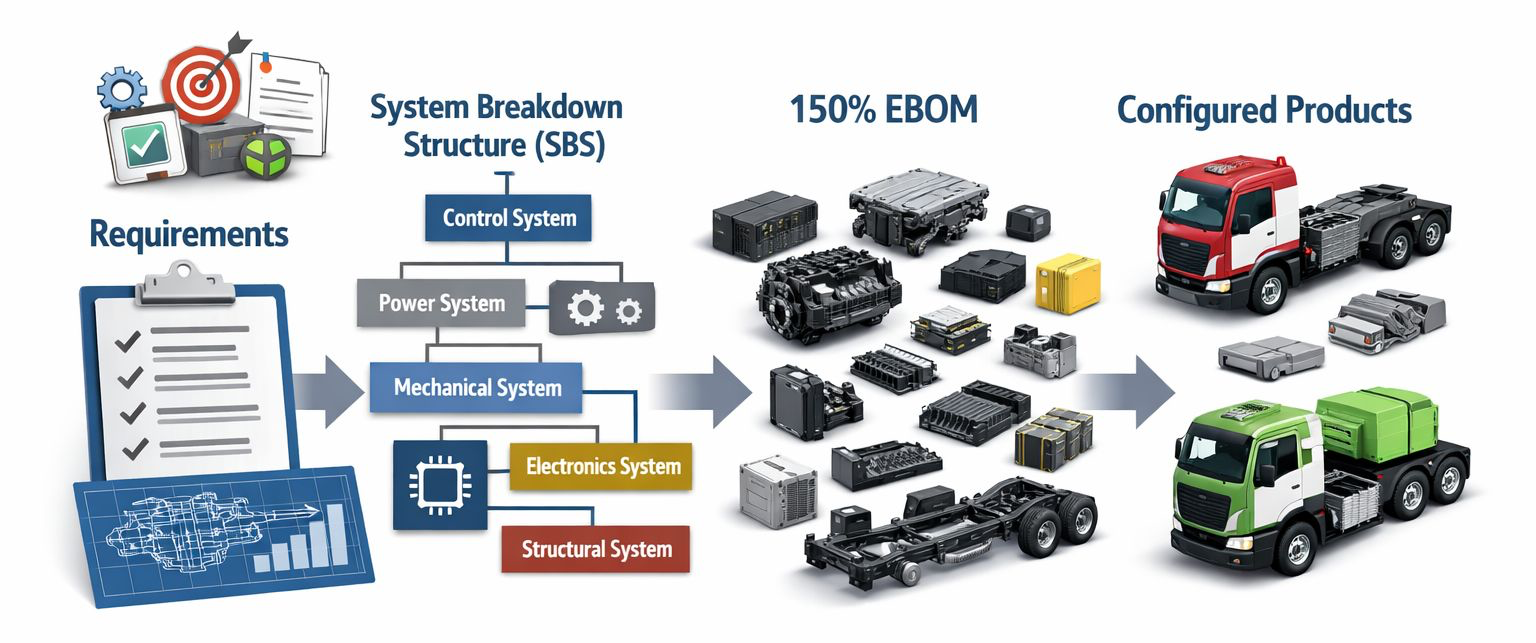
The journey starts with requirements. These capture what the product must do: Performance targets, regulatory constraints, operational needs, and customer expectations. Requirements describe capabilities, not components.
From these requirements, systems engineers develop the System Breakdown Structure (SBS). The SBS decomposes the product into systems and subsystems based on functional responsibility; propulsion, control, energy, structure, electronics, and so on. Each system becomes responsible for fulfilling a specific set of requirements and defining the interfaces to other systems.
Here the product architecture begins to take shape.
Product engineering then translates this architecture into the physical product structure. Each system defined in the SBS is implemented as a module or assembly in the Engineering Bill of Materials (EBOM). To support product families and variants, this is typically represented as a 150% EBOM, containing all modules and variant options across the platform.
From the 150% EBOM configuration logic then selects the appropriate modules to create a specific 100% product EBOM for a customer order, region or production variant.
When this process is executed in an integrated environment, powerful benefits emerge.
Requirements remain traceable to the systems that fulfill them. Systems remain linked to the modules and assemblies that implement them. Changes in requirements or architecture can be traced directly to the affected product structures and configurations, and determining technical and financial impacts becomes quick and easy.
This integration also supports better modularization based on changing requirements. Systems engineering defines clear functional boundaries and interfaces, which translate into well-defined product modules in the EBOM.
In short, integrating systems engineering with product engineering creates a continuous digital thread:
Requirements → Systems → Modules → Product Family → Customer Specific Product Configuration.
And that integration is what ultimately enables companies to build complex, configurable products faster, with better control over architecture, variants, and lifecycle changes and ultimately quickly configure a product that meets specific customer requirements.