PLM Library · Book chapter
Crafting Platform Strategy Based on Anticipated Benefits and Costs
- Author
- Bruce G. Cameron, Edward F. Crawley
- Publisher
- Springer
- Series
- Advances in Product Family and Product Platform Design
- Year
- 2013
Summary
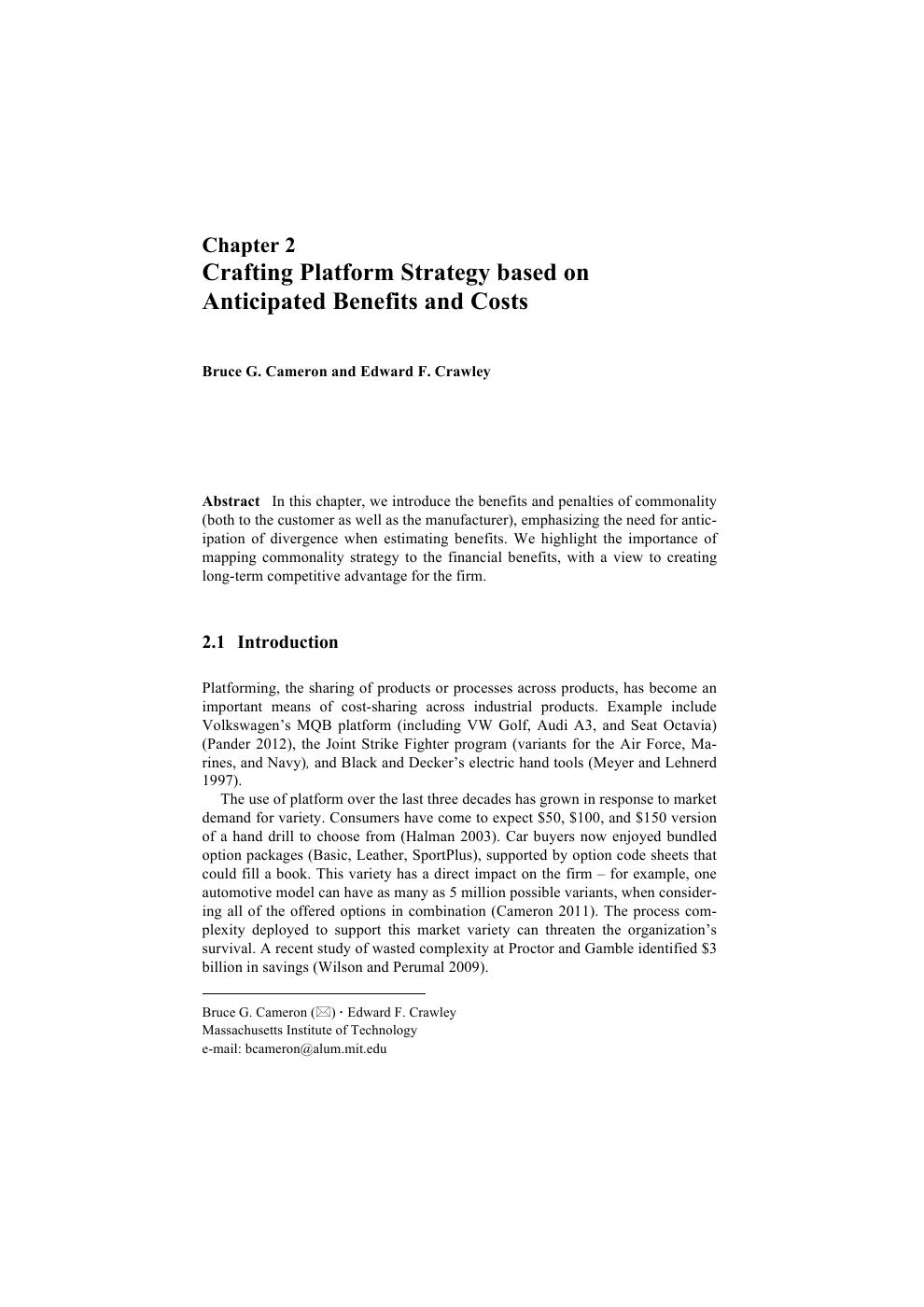
Examines the benefits and penalties of commonality for customers and manufacturers, emphasizing how divergence between product variants can erode expected benefits. The chapter connects commonality strategy with financial outcomes and the pursuit of long-term competitive advantage.
It helps readers develop a realistic business case for product platforms by considering not only component sharing, but also the costs and risks of sustaining that sharing as products evolve.
Our verdict
Recommended for developing the business case for product platforms. A focused companion to architecture and modularization texts that encourages realistic benefit estimates rather than assuming reuse automatically delivers savings.
Who should read it
- —Product platform leaders building investment cases
- —Engineering and finance teams evaluating commonality
- —PLM consultants assessing product-family strategies
How it relates to your work
- —Test expected platform savings against likely divergence and customization.
- —Link reuse decisions and product-family governance to measurable financial benefits.
Keep in mind
- —A book chapter, not a standalone book; a free author manuscript is available through MIT.
- —MIT cites publication in July 2013 and a 2014 Springer copyright; the library uses the publication year 2013.
- —The author manuscript may differ in formatting from the publisher's version.