Magic Quadrant for PLM Software in Discrete Manufacturing Industries
- Author
- Sudip Pattanayak, Marc Halpern, et al.
- Publisher
- Gartner
- Year
- 2026
Summary
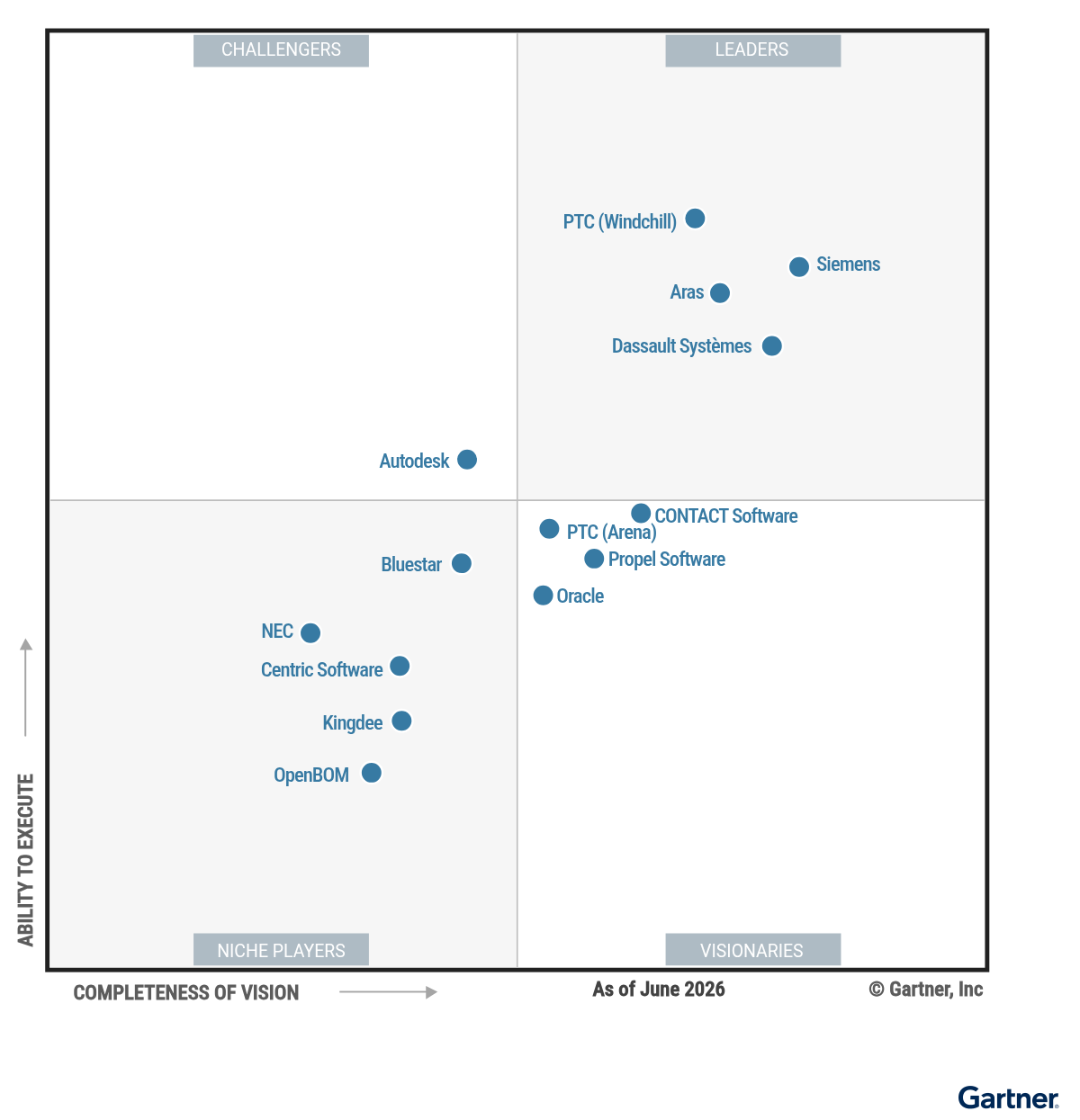
Gartner's 2026 Magic Quadrant evaluates PLM software vendors for discrete manufacturing, defining the market around mandatory capabilities such as multidomain CAD integration, digital thread enablement, product structure and BOM management, integrated product development, decision intelligence, quality and compliance management, AI-enabled data authoring, and enterprise APIs.
The report assesses 14 vendors — Aras, Autodesk, Bluestar, Centric Software, CONTACT Software, Dassault Systèmes, Kingdee, NEC, OpenBOM, Oracle, Propel Software, PTC (Arena and Windchill) and Siemens — with strengths and cautions for each, plus optional capabilities including MBSE orchestration, ALM integration, sustainability workflows, IoT integration and agentic AI architectures.
Gartner expects that by 2030 over 60% of manufacturers will rely on PLM as a core system for AI-driven product innovation and development, up from about 20% today.
Our verdict
Recommended reading — free licensed reprint. The most current analyst view of the PLM vendor landscape: useful for vendor shortlisting and for understanding which capabilities Gartner considers mandatory in a modern PLM platform.
Who should read it
- —Executives and CIOs shortlisting PLM vendors for discrete manufacturing
- —PLM program managers building evaluation criteria and RFPs
- —Consultants and analysts tracking the PLM market and vendor positioning
How it relates to your work
- —The mandatory and optional feature lists map directly to PLM requirements specification and vendor evaluation.
- —Vendor strengths and cautions complement the PLM Directory profiles when comparing systems.
Keep in mind
- —Analyst opinion, not a hands-on evaluation; validate against your own requirements and proofs of concept.
- —Focused on discrete manufacturing; process-industry PLM is out of scope.