Product Lifecycle Management
Driving the Next Generation of Lean Thinking
- Author
- Michael Grieves
- Publisher
- McGraw-Hill
- Edition
- 1st edition
- Year
- 2006
- Pages
- 319
- ISBN
- 978-0-07-145230-4 (hardcover) · 978-0-07-178630-0 (eBook)
Summary
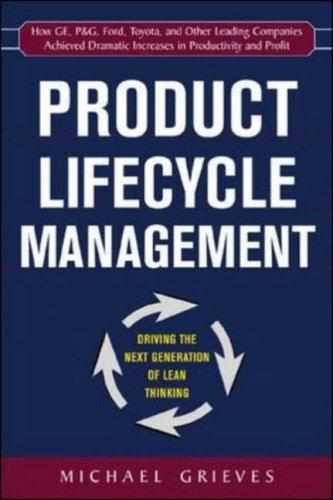
Michael Grieves presents PLM as a business approach in which information substitutes for wasted time, energy and material — extending lean thinking across the whole product lifecycle.
The book defines PLM through a lifecycle model (plan, design, build, support, dispose), traces its roots in CAD, EDM, PDM and CIM, and compares it with lean manufacturing, ERP and CRM. It introduces the Information Mirroring Model and PLM characteristics such as singularity, correspondence, cohesion and traceability.
Later chapters examine the external and internal drivers of PLM, the people–process–technology elements, and collaborative product development topics such as requirements, part numbering, vaulting, reuse and engineering change management.
Our verdict
Recommended for the 'why'. One of the clearest explanations of PLM's business rationale, and the origin of the Information Mirroring Model that later became the digital twin concept — read it to argue for PLM, not to plan the implementation details.
Who should read it
- —Executives and PLM sponsors building the business case
- —PLM leads who want to connect PLM with lean and operational excellence
- —Readers interested in the conceptual origins of the digital twin
How it relates to your work
- —Its waste-reduction framing helps position PLM in lean and continuous-improvement programmes.
- —The comparison with ERP and CRM clarifies system boundaries in enterprise architecture discussions.
- —The Information Mirroring Model underpins today's digital twin and digital thread thinking.
Keep in mind
- —Published in 2005/2006; company examples and technology references are dated.
- —Strongest on concepts and rationale; lighter on step-by-step implementation.