CIM Computer Integrated Manufacturing
Towards the Factory of the Future
- Author
- August-Wilhelm Scheer
- Publisher
- Springer
- Edition
- 3rd edition (latest English edition)
- Year
- 1994
- Pages
- 303
- ISBN
- 978-3-642-78990-8 (softcover) · 978-3-642-78988-5 (eBook)
Summary
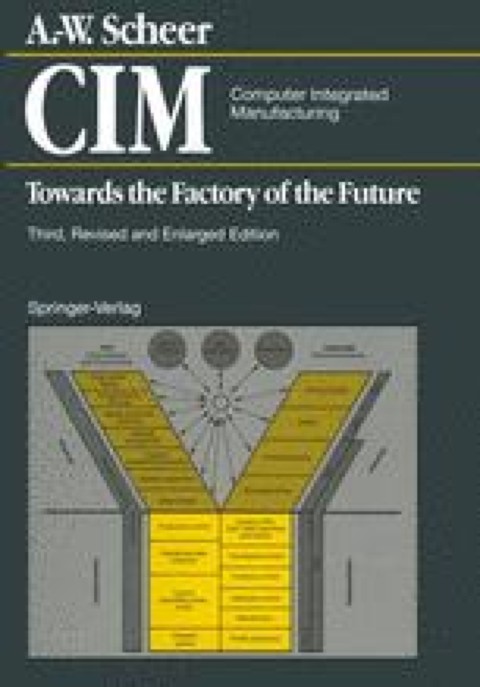
August-Wilhelm Scheer's classic on Computer Integrated Manufacturing (CIM) treats the computerized handling of integrated business processes across all functions of an industrial enterprise — from design and production planning to manufacturing control.
The book describes the current state of applications and the new demands arising from the integration principle, and emphasizes strategies for the realization and implementation of CIM based on the author's concrete project experience.
At its core is the “Y-CIM information management” model, which separates technical (CAD, CAP, CAM) and commercial (PPC, order processing) functions and links them through a common production database — a procedural method for implementing integration that became a blueprint for the process-oriented enterprise architecture thinking behind Scheer's later ARIS framework.
The third edition supplements earlier material with up-to-date examples of applied CIM solutions and transfer strategies, showing how integration concepts were put into practice in real factories.
Our verdict
Worth reading for context. The foundational work that shaped how integrated product and production data management was understood in industry — valuable as the intellectual root of today's PLM and digital thread thinking, not as a modern how-to guide.
Who should read it
- —PLM professionals who want to understand the historical roots of integrated enterprise systems
- —Consultants and IT architects working with German and European manufacturers where CIM thinking still shapes terminology
- —Readers interested in the origins of process-oriented enterprise modeling (ARIS) and the Y-CIM model
- —Students studying the evolution from CIM and PDM towards PLM and Industry 4.0
How it relates to your work
- —The Y-CIM model helps structure how technical and commercial functions should share one consistent data foundation — the same problem today's digital thread solves.
- —Its integration-first argument is a useful counterpoint to tool-first PLM initiatives: connect processes before buying software.
- —Understanding CIM-era terminology helps when working with established manufacturers whose process landscapes grew out of these concepts.
Keep in mind
- —Written in 1994: technology examples (hardware, interfaces, office systems) are dated and should be read as historical context.
- —The vocabulary differs from modern PLM and ERP terminology, so readers need to map concepts rather than match names.
- —An academic, model-driven style — dense in places and best approached chapter by chapter rather than cover to cover.