What is worth reading in PLM.
Books, papers and articles on PLM, new product development, innovation, configuration management and modularization — each with a brief summary and our editorial judgment on who should read it and why.
Cradle to Cradle
Remaking the Way We Make Things
William McDonough, Michael Braungart · 2002 · North Point Press (Macmillan)
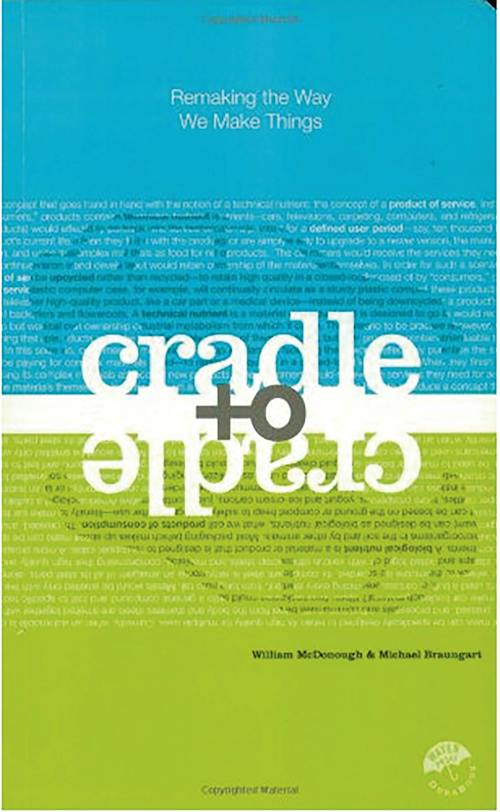
An architect and a chemist argue that 'less bad' eco-efficiency is not enough, and that products should instead be designed from the start so their materials can circulate safely and indefinitely.
Our verdict: Recommended reading. The foundational, highly readable manifesto behind circular design; it reshapes how you think about materials and end of life, even if it offers little implementation detail.
Read the full review →Design Rules, Volume 1
The Power of Modularity
Carliss Y. Baldwin, Kim B. Clark · 2000 · MIT Press
Baldwin and Clark explain modularity as an economic force: how splitting a design into modules connected by visible design rules creates options, enables parallel work and changes the structure of industries.
Our verdict: Recommended reading for the theory behind modularization. Demanding but foundational: it explains why modular architectures create value, not just how to draw them — essential background for serious platform and modularity work.
Read the full review →Stage-gate systems: A new tool for managing new products
Robert G. Cooper · 1990 · Business Horizons, Vol. 33(3), pp. 44–54
The foundational article on Stage-Gate: organizing new product development into defined stages separated by decision gates where projects are continued, held or stopped.
Our verdict: Recommended for context. A short, readable original source for the stage-gate concept that most development organizations use in some form — the article behind Cooper's later books.
Read the full review →The New New Product Development Game
Hirotaka Takeuchi, Ikujiro Nonaka · 1986 · Harvard Business Review, January 1986
The classic Harvard Business Review article that compared fast, flexible product development to rugby: a self-organizing, cross-functional team moving the ball down the field together, rather than passing it relay-style between departments.
Our verdict: Recommended reading. Short and influential: the article that gave agile development its 'scrum' metaphor and still explains why overlapping, empowered teams outrun sequential development.
Read the full review →Know a resource worth reading?
Suggest a book, paper, article or report that belongs in the PLM Library. Send us its name and a link and we will review it for inclusion.
Sign in or register to suggest a resource →Summaries and verdicts are PLMadvisors' independent editorial opinions. No paid placement.