What is worth reading in PLM.
Books, papers and articles on PLM, new product development, innovation, configuration management and modularization — each with a brief summary and our editorial judgment on who should read it and why.
Managing Innovation
Integrating Technological, Market and Organizational Change
Joe Tidd, John Bessant · 8th edition · 2025 · Wiley
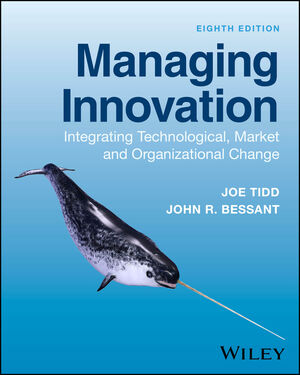
A standard textbook on innovation management that treats innovation as the integration of technological, market and organizational change rather than a purely technical activity.
Our verdict: Recommended reading. Places organizational change within the broader innovation system — useful for examining the structures, capabilities and management practices a PLM or innovation initiative depends on.
Read the full review →Unleashing the Power of Artificial Intelligence in New Product Development
Building AI Into Your Stage-Gate® New-Product Process
Robert G. Cooper · 2024 · Stage-Gate International
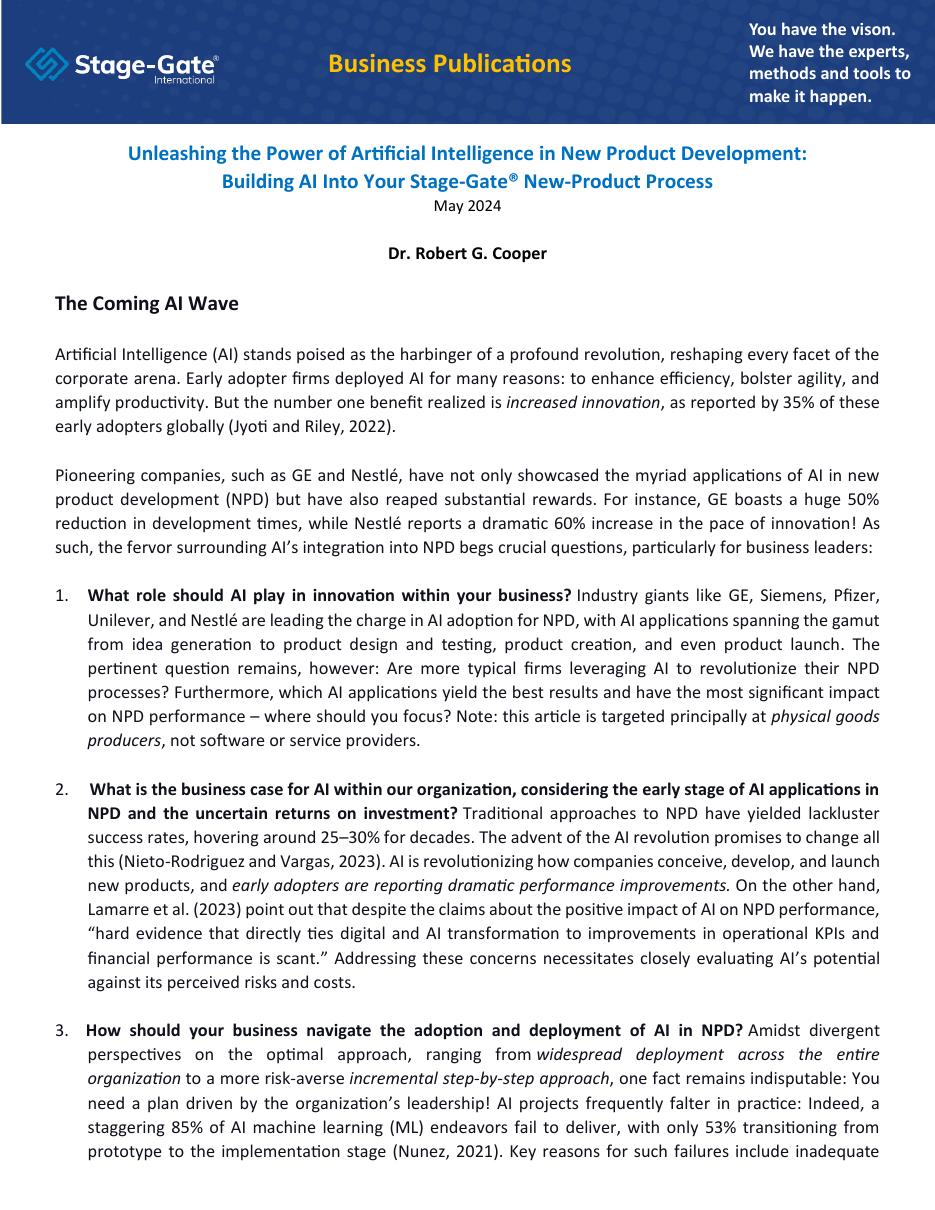
Cooper examines how companies, particularly physical-goods producers, can use AI across new product development — from idea generation and product design and testing to product creation and launch.
Our verdict: Worth reading — free. A practical, accessible introduction to applying AI in product development. Note that it is practitioner material from the Stage-Gate ecosystem rather than independent peer-reviewed research.
Read the full review →Digital Twin in Industry: State-of-the-Art
Fei Tao, He Zhang, Ang Liu, A. Y. C. Nee · 2019 · IEEE Transactions on Industrial Informatics, Vol. 15, No. 4
A widely cited review of digital twin research and industrial practice.
Our verdict: Worth reading as a reference. A foundational overview of the digital twin field — best used to understand the landscape and terminology rather than as a practical guide.
Read the full review →Digital Twin in manufacturing: A categorical literature review and classification
Werner Kritzinger, Matthias Karner, Georg Traar, Jan Henjes, Wilfried Sihn · 2018 · IFAC-PapersOnLine, Vol. 51, No. 11 (Elsevier)
A literature review that brings order to the many uses of the term "digital twin" in manufacturing.
Our verdict: Recommended — short and useful. The model / shadow / twin distinction is a simple, practical way to cut through vendor marketing and agree on what a "digital twin" project actually means.
Read the full review →Oslo Manual 2018
Guidelines for Collecting, Reporting and Using Data on Innovation
OECD, Eurostat · 4th edition · 2018 · OECD Publishing / Eurostat
The international reference for defining and measuring innovation, jointly published by the OECD and Eurostat as part of the series on the measurement of scientific, technological and innovation activities.
Our verdict: Useful reference — free. The authoritative source for innovation definitions and metrics; consult it when you need consistent terminology or want to measure innovation rigorously.
Read the full review →Designing the Future
How Ford, Toyota, and other World-Class Organizations Use Lean Product Development to Drive Innovation and Transform Their Business
James M. Morgan, Jeffrey K. Liker · 2018 · McGraw-Hill Education
Drawing on the authors' work with Ford's global product development transformation and research on Toyota, this book explains how leading companies redesign their product development systems around lean principles.
Our verdict: Recommended reading for transformation leaders. Particularly relevant when a PLM initiative accompanies a redesign of how engineering and development teams work — it addresses the organizational side that tool projects often underestimate.
Read the full review →Winning at New Products
Creating Value Through Innovation
Robert G. Cooper · 5th edition · 2017 · Basic Books
Robert Cooper's book covers innovation management and decision-making from idea generation through launch, based on his research into what distinguishes successful new products.
Our verdict: Recommended reading for development governance. The standard work on Stage-Gate and portfolio management — useful whenever the question is which projects to fund and how to steer them, rather than how to engineer the product.
Read the full review →Product design and business model strategies for a circular economy
Nancy M. P. Bocken, Ingrid de Pauw, Conny Bakker, Bram van der Grinten · 2016 · Journal of Industrial and Production Engineering (Taylor & Francis)
This widely cited open-access paper builds a framework that links circular product design strategies with business model strategies for a circular economy.
Our verdict: Worth reading — free. A concise, practical framework that connects circular design choices with business models; a good bridge between sustainability goals and product development decisions.
Read the full review →Democratizing Innovation
Eric von Hippel · 2005 · MIT Press
Von Hippel shows that users — both individuals and firms — are often the first to develop new products and services, and explains why they innovate and freely share their innovations.
Our verdict: Worth reading — and freely available. An influential, evidence-based case for involving lead users and customers directly in product innovation.
Read the full review →Open Innovation
The New Imperative for Creating and Profiting from Technology
Henry Chesbrough · 2003 · Harvard Business School Press
Chesbrough contrasts the traditional 'closed' model of innovation, in which companies generate, develop and commercialize ideas entirely in-house, with an 'open' model that deliberately uses external ideas and external paths to market.
Our verdict: Recommended reading. The book that defined open innovation — still the clearest explanation of why external knowledge, IP strategy and business models matter as much as internal R&D.
Read the full review →Know a resource worth reading?
Suggest a book, paper, article or report that belongs in the PLM Library. Send us its name and a link and we will review it for inclusion.
Sign in or register to suggest a resource →Summaries and verdicts are PLMadvisors' independent editorial opinions. No paid placement.