What is worth reading in PLM.
Books, papers and articles on PLM, new product development, innovation, configuration management and modularization — each with a brief summary and our editorial judgment on who should read it and why.
Digital Twin in manufacturing: A categorical literature review and classification
Werner Kritzinger, Matthias Karner, Georg Traar, Jan Henjes, Wilfried Sihn · 2018 · IFAC-PapersOnLine, Vol. 51, No. 11 (Elsevier)
A literature review that brings order to the many uses of the term "digital twin" in manufacturing.
Our verdict: Recommended — short and useful. The model / shadow / twin distinction is a simple, practical way to cut through vendor marketing and agree on what a "digital twin" project actually means.
Read the full review →Toward a Lifecycle Information Framework and Technology in Manufacturing
Thomas Hedberg Jr., Allison Barnard Feeney, Moneer Helu, Jaime A. Camelio · 2017 · Journal of Computing and Information Science in Engineering, Vol. 17, No. 2 (ASME)
This NIST-led paper addresses a core digital thread problem: product lifecycle information sits in many separate repositories and is hard to link, put into context and reuse.
Our verdict: Recommended for digital thread work. One of the clearest early descriptions of what connecting lifecycle data across repositories actually requires — and a free NIST manuscript is available.
Read the full review →NASA Systems Engineering Handbook
NASA · Revision 2 · 2016 · NASA (NASA/SP-2016-6105 Rev 2)
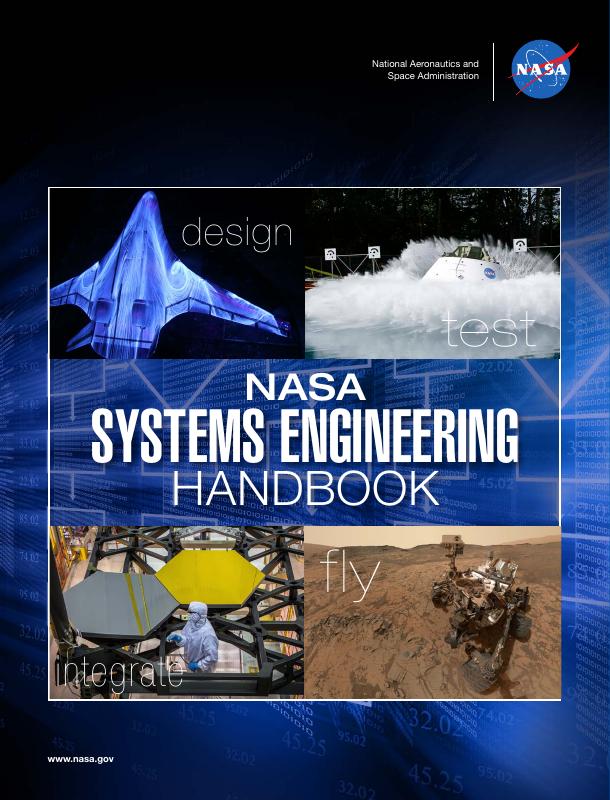
NASA's practical handbook on systems engineering, describing the system lifecycle processes used in one of the world's most demanding engineering organizations.
Our verdict: Recommended reading — and free. An unusually practical systems engineering handbook with concrete process descriptions and examples that industrial teams can adapt directly, especially for configuration and technical data management.
Read the full review →Closed-loop PLM for intelligent products in the era of the Internet of things
Dimitris Kiritsis · 2011 · Computer-Aided Design, Vol. 43, pp. 479–501
The paper describes closed-loop PLM: using information gathered from products during use, service and end of life to support decisions across the whole lifecycle.
Our verdict: Worth reading for the vision. An early, influential statement of connecting PLM with field data from products in use — the foundation for today's IoT-enabled PLM, service lifecycle management and digital twins.
Read the full review →Engineering change: An overview and perspective on the literature
Timothy A. W. Jarratt, Claudia M. Eckert, Nicholas H. M. Caldwell, P. John Clarkson · 2011 · Research in Engineering Design, Vol. 22, pp. 103–124
A comprehensive review of the engineering change literature, covering the change process, change propagation, change prediction and the factors that make changes to released product information difficult and expensive.
Our verdict: Recommended reading for anyone working on change processes. The best single overview of engineering change management: it explains why changes propagate and what makes them costly — the problem that PLM change workflows exist to control.
Read the full review →Product lifecycle management – from its history to its new role
Sergio Terzi, Abdelaziz Bouras, Debashi Dutta, Marco Garetti, Dimitris Kiritsis · 2010 · International Journal of Product Lifecycle Management, Vol. 4, No. 4, pp. 360–389
Written after broad consultation among the authors and with scientists and leading actors in the PLM field, the paper discusses PLM as a reference term for a set of developments in the industrial community.
Our verdict: Worth reading for context. A well-cited academic overview of where PLM came from and what it consists of — useful background for anyone writing or teaching about PLM.
Read the full review →Product Lifecycle Management
Antti Saaksvuori, Anselmi Immonen · 3rd edition · 2008 · Springer
A compact introduction to product lifecycle management (formerly, in a narrower sense, product data management) for companies in manufacturing, high technology and service industries facing shorter lifecycles and pressure to bring products to market faster.
Our verdict: Worth reading as a foundation. A clear, compact introduction to product structures, PLM systems, integration and deployment — good for building a shared vocabulary, though the technology examples predate cloud PLM and the digital thread.
Read the full review →Product Lifecycle Management
Driving the Next Generation of Lean Thinking
Michael Grieves · 1st edition · 2006 · McGraw-Hill
Michael Grieves presents PLM as a business approach in which information substitutes for wasted time, energy and material — extending lean thinking across the whole product lifecycle.
Our verdict: Recommended for the 'why'. One of the clearest explanations of PLM's business rationale, and the origin of the Information Mirroring Model that later became the digital twin concept — read it to argue for PLM, not to plan the implementation details.
Read the full review →Product Lifecycle Management: Closing the Knowledge Loops
Farhad Ameri, Deba Dutta · 2005 · Computer-Aided Design & Applications, Vol. 2, No. 5, pp. 577–590
Starting from the failure of the Swedish warship Vasa as an example of poor learning, feedback and organisational memory in product development, the paper argues that these problems still undermine product realisation today.
Our verdict: Worth reading — short and free. A concise academic explanation of why PLM is ultimately about capturing and reusing knowledge, not just managing files; a good primer before larger books.
Read the full review →A product information modeling framework for product lifecycle management
R. Sudarsan, S. J. Fenves, R. D. Sriram, F. Wang · 2005 · Computer-Aided Design, Vol. 37, No. 13 (Elsevier)
This paper from NIST researchers argues that PLM needs product information models that go beyond the geometry and file-level data exposed by CAD and PDM systems.
Our verdict: Worth reading for data architects. A clear academic statement of why PLM needs a richer, system-independent product information model — useful background for anyone defining a product data model, less so for business readers.
Read the full review →Know a resource worth reading?
Suggest a book, paper, article or report that belongs in the PLM Library. Send us its name and a link and we will review it for inclusion.
Sign in or register to suggest a resource →Summaries and verdicts are PLMadvisors' independent editorial opinions. No paid placement.